





Book Title: Millennium Referendum Initiative
Subtitle: Democratic Authorization of Sub-Saharan African Unity
The Unthinkable. The Imperative. The Irrevocable
From the outset, African unity was articulated as a political necessity rather than a popular mandate. The Addis Ababa Conference of 1963 acknowledged the imperative of continental unity but institutionalized it through a loose intergovernmental organization that preserved national sovereignty intact (OAU, 1963). The resulting non-interference doctrine embedded in the OAU Charter transformed unity into a diplomatic aspiration rather than an enforceable project (Murithi, 2005).
Subsequent economic strategies—including the Monrovia Declaration and the Lagos Plan of Action—correctly diagnosed fragmentation and external dependence as central obstacles to development, yet relied entirely on voluntary state compliance, leaving them vulnerable to elite reversal and donor pressure (OAU, 1979; OAU, 1980; Mkandawire, 2001). Similarly, the African Charter on Human and Peoples’ Rights articulated an ambitious continental rights framework without endowing supranational institutions with binding authority, resulting in uneven enforcement across member states (OAU, 1981; Viljoen, 2012).
The Abuja Treaty of 1991 represented the most systematic attempt to translate unity into economic integration, yet its reliance on overlapping regional economic communities and non-binding timelines reproduced the same sovereignty veto that had constrained earlier efforts (OAU, 1991). Later frameworks—including the Cairo Agenda, the AU Constitutive Act, NEPAD, and Agenda 2063—expanded ambition dramatically but left enforcement mechanisms largely unchanged, producing what can be described as promise inflation without authority transfer (AU, 2000; AU, 2001; AU, 2013).
Across six decades, the recurring failure of African integration initiatives is therefore not conceptual but constitutional: unity was repeatedly promised without democratic authorization. A sub-Saharan Africa-wide referendum directly addresses this foundational deficit by relocating legitimacy from elite consensus to popular sovereignty, thereby enabling binding delegation of authority for the first time.
Book Description
The manuscript argues that the current historical moment makes democratic reauthorization both urgent and viable. Sub-Saharan Africa faces converging pressures:
- Persistent economic vulnerability
- Fragmented security responses
- Demographic transformation driven by youth
- Declining legitimacy of inherited political structures
At the same time, Sub-Saharan Africa possesses unprecedented assets:
- High electoral participation norms
- Shared institutional experience
- Regional political consciousness
- Technological capacity for mass civic engagement
In this context, postponing popular authorization is no longer neutral—it is destabilizing.
Contribution Statement
This manuscript advances a novel institutional argument about African political economy and post-colonial governance. Rather than attributing Sub-Saharan Africa’s persistent development, security, and integration challenges primarily to leadership failure, policy error, or weak implementation, the book reframes these outcomes as the consequence of a structural mismatch between political authority and the scale at which sub-Saharan Africa’s core problems operate.
The book’s central contribution is to demonstrate that six decades of African institutional reform—from independence through successive continental frameworks—have repeatedly diagnosed the same structural constraints (fragmentation, limited market size, weak collective capacity) while consistently deferring the question of political authorization required to address them. African integration, the manuscript shows, has been pursued through treaties, declarations, and institutional proliferation without ever resolving the constitutive issue of who authorizes authority beyond the nation-state. The result is a recurring pattern of ambition without mandate and coordination without enforceability.
The manuscript makes three distinct contributions to the literature:
- Conceptual Contribution
It introduces a unifying analytical framework—promise inflation versus authority stagnation—to reinterpret African integration history as a single unresolved institutional problem rather than a series of discrete failures. This reframing moves debates beyond normative arguments about unity toward a procedural analysis of authorization, legitimacy, and scale. - Comparative Contribution
Through tightly bounded comparative references to the United States, India, and the European Union, the book situates Africa’s experience within a broader theory of large-scale political integration. These cases are used selectively to demonstrate that durable collective governance elsewhere has depended on explicit constitutive moments of authorization, while their absence produces persistent legitimacy constraints. The comparisons are limited in scope and serve to generalize the argument without displacing its Africa-centered focus. - Institutional and Theoretical Contribution
The book advances the concept of democratic authorization—specifically, the referendum—as a constitutional mechanism rather than a policy proposal. Importantly, it treats all possible authorization outcomes (affirmative, negative, or partial) as analytically productive, emphasizing that institutional clarity itself constitutes progress relative to prolonged ambiguity. In doing so, the manuscript contributes to broader debates on sovereignty, federalism, and post-colonial statehood.
Positioned at the intersection of African political economy, comparative politics, and institutional theory, the manuscript offers a reinterpretation of African unity that is neither teleological nor advocative. Its core claim is that sub-Saharan Africa’s post-colonial condition is best understood as a prolonged deferral of political decision at the scale required by structural reality—and that confronting this deferral, democratically, is now unavoidable.
Why did I write The Referendum?
After decades of studying development, governance, and regional integration in Sub-Saharan Africa, I became increasingly convinced that many of the region’s challenges share a common characteristic:
They operate across borders.
Infrastructure networks, trade systems, energy markets, migration flows, environmental pressures, and security threats rarely stop at national boundaries.
Yet political authority remains largely organized within them.
This observation led me to a simple question:
Have Sub-Saharan Africa’s economic realities outgrown the institutional scale inherited from the post-independence era?
The Referendum is my attempt to explore that question.
The book examines whether the region’s persistent development challenges are, in part, a consequence of a growing mismatch between the scale of contemporary challenges and the scale of existing governance arrangements.
Whether readers agree with my conclusions or not, I hope the book contributes to a constructive debate about governance, legitimacy, development, and the future of Sub-Saharan Africa.
What do you think? Have today’s challenges outgrown the institutions designed to address them?
#TheReferendum #SubSaharanAfrica #AfricanDevelopment #Governance #RegionalIntegration #PublicPolicy
GOVERNANCE SCALE GAP



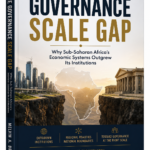
Book Title: The Governance Scale Gap
Subtitle: Why Sub-Saharan Africa’s Economic Systems Outgrew Its Institutions
After years of studying governance, regional integration, and economic development in Sub-Saharan Africa, I became increasingly convinced that many of the region’s most persistent challenges share a common characteristic:
They operate across borders, while the institutions responsible for addressing them remain largely organized within national boundaries.
Trade corridors, energy systems, transportation networks, environmental pressures, migration, investment, and regional security increasingly function at a scale that exceeds the institutional capacity of individual states acting alone.
This mismatch—what I describe as the governance scale gap—raises an important question:
Have Sub-Saharan Africa’s economic realities outgrown the governance structures inherited from the post-independence era?
This book explores that question through the lenses of development economics, political economy, institutional design, and regional integration. Rather than prescribing simple solutions, it examines whether aligning governance with the scale of today’s economic and social realities could unlock new opportunities for sustainable development.
Whether readers ultimately agree with my conclusions or not, I hope this work contributes to a thoughtful and constructive discussion about governance, institutional effectiveness, and the future of Sub-Saharan Africa.
You can learn more about the book here:
https://lnkd.in/eZvk-Kk5
I look forward to your thoughts and to engaging in a respectful dialogue on these important issues.
#Governance #DevelopmentEconomics #RegionalIntegration #PublicPolicy #Institutions #EconomicDevelopment #SubSaharanAfrica #AfricanDevelopment #PoliticalEconomy #Leadership
What Is the Governance Scale Gap?
One question has shaped much of my recent research:
Why do many of Sub-Saharan Africa’s development challenges persist despite decades of policy reforms, regional initiatives, and international partnerships?
My book, The Governance Scale Gap, proposes one possible explanation.
Economic activity in Sub-Saharan Africa has increasingly expanded beyond national borders. Regional trade, transportation corridors, energy systems, financial markets, migration, environmental management, and security challenges now operate at a regional scale.
Yet political authority remains overwhelmingly organized at the level of individual nation-states.This creates what I call the governance scale gap—a growing mismatch between the scale of the problems and the scale of the institutions expected to address them.
When institutions are smaller than the systems they govern, coordination becomes more difficult, costs increase, implementation slows, and opportunities for shared prosperity can be lost. T
his idea is not an argument against national sovereignty. Rather, it is an invitation to ask whether governance arrangements should evolve alongside changing economic realities.
Whether readers ultimately agree with this framework or not, I hope it encourages a broader discussion about institutional effectiveness, regional cooperation, and the future of development in Sub-Saharan Africa.
What are your thoughts?
Can governance structures designed decades ago effectively address today’s increasingly interconnected regional challenges?
The Governance Scale Gap: Why Sub-Saharan Africa’s Economic Systems Outgrew Its Institutions is available here:
#Governance #DevelopmentEconomics #RegionalIntegration #PublicPolicy #Institutions #EconomicDevelopment #SubSaharanAfrica #PoliticalEconomy
The Governance Scale Gap and Africa’s Integration Challenge
For more than six decades, African leaders and institutions have consistently emphasized the importance of regional cooperation and economic integration. From the creation of the Organization of African Unity in 1963 to the establishment of the African Union and the more recent launch of the African Continental Free Trade Area, the vision of a more integrated continent has remained central to African political thought.
These ambitions reflect an important structural reality. Many African economies emerged from colonial rule with relatively small domestic markets and infrastructure systems designed primarily to connect inland production zones to coastal export ports. Expanding markets through regional integration has therefore long been viewed as an essential strategy for economic transformation.
Yet despite decades of institutional commitments, Sub-Saharan Africa remains the least economically integrated region in the global economy. Trade among African countries accounts for a smaller share of total commerce than in most other regions. Infrastructure networks often stop at national borders, and many regional initiatives depend on complex negotiations among sovereign governments.
This persistent gap between institutional aspirations and economic outcomes raises an important question: why has regional economic integration in Sub-Saharan Africa progressed more slowly than many policymakers once expected?
Several explanations have been offered. Analysts often emphasize governance challenges within individual states, the legacy of colonial borders, or the effects of global economic pressures. While these factors may all play a role, another structural dimension deserves closer attention: the relationship between the scale of economic systems and the scale of governance institutions.
Across the continent today, many economic systems operate increasingly across national borders. Trade networks connect producers and consumers across neighboring countries. Infrastructure corridors link inland regions to ports and regional markets. Telecommunications systems and digital platforms enable economic interaction across wide geographic areas.
However, governance authority remains largely organized within sovereign states. Nearly fifty national governments maintain separate regulatory frameworks, economic policies, and administrative systems.
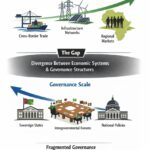
This divergence between the scale of economic systems and the scale of governance institutions creates what can be described as the Governance Scale Gap.
The Governance Scale Gap refers to a structural mismatch between the geographic scale at which economic systems operate and the institutional scale at which governance authority is exercised. When economic systems span multiple jurisdictions while governance authority remains fragmented among them, coordination challenges arise that can affect infrastructure development, trade integration, and economic policy implementation.
Infrastructure development provides a clear example of this dynamic. Many transportation corridors, energy systems, and telecommunications networks naturally extend across multiple countries. A railway linking inland agricultural regions to coastal ports may pass through several national territories. Similarly, regional electricity pools can help countries balance supply and demand more efficiently.
However, projects that span multiple jurisdictions require coordination among several governments, each operating within its own regulatory and administrative framework. Differences in policy priorities, financing arrangements, and institutional capacity can slow the implementation of infrastructure initiatives that would otherwise support regional economic development.
Trade integration presents similar challenges. Cross-border commerce often involves multiple regulatory systems, customs procedures, and administrative requirements. While initiatives such as the African Continental Free Trade Area aim to reduce tariffs and facilitate trade, effective implementation requires sustained coordination among national governments.
The Governance Scale Gap does not imply that regional integration is impossible. In fact, African institutions have made significant progress in developing frameworks for cooperation. Organizations such as the African Union provide important platforms for dialogue and coordination among governments, while regional economic communities have contributed to the development of trade agreements and infrastructure initiatives.
However, the persistence of nationally organized governance structures means that economic systems operating across borders often require complex negotiations among multiple jurisdictions.
A second dynamic also emerges when examining the institutional history of African cooperation. African leaders have repeatedly articulated ambitious visions for continental unity and economic integration. Yet the authority required to implement these commitments has often remained decentralized among sovereign states.
This divergence between institutional ambition and institutional authority can be described as the Promise–Authority Gap.
Together, these two dynamics—the Governance Scale Gap and the Promise–Authority Gap—provide a useful framework for understanding the institutional challenges that continue to shape regional integration across Sub-Saharan Africa.
Recognizing these structural dynamics does not diminish the importance of regional cooperation. On the contrary, it highlights why institutional innovation remains essential for the continent’s economic future. As trade networks, infrastructure systems, and markets increasingly operate across borders, governance institutions may face growing pressure to adapt in ways that facilitate coordination at broader geographic scales.
Initiatives such as the African Continental Free Trade Area represent important steps toward strengthening regional economic cooperation. By reducing trade barriers and promoting greater economic interaction among African economies, such initiatives have the potential to expand markets and create new opportunities for industrial development.
However, the long-term success of these initiatives may depend not only on economic incentives but also on the evolution of institutional frameworks capable of coordinating policies across multiple jurisdictions.
Understanding the Governance Scale Gap therefore provides a useful lens for examining the institutional foundations of African economic transformation. As the continent’s economic systems continue to expand and diversify, the relationship between governance structures and economic scale will likely remain a central issue in debates about regional integration and development.