Somalia
Country Flag Details
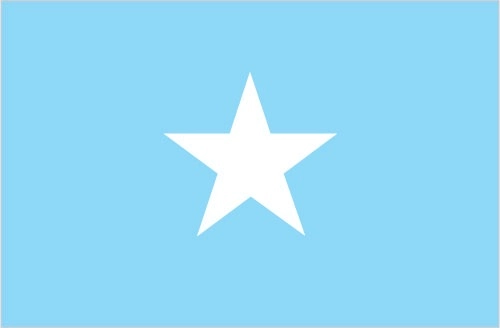
light blue with a large white five-pointed star in the center; the blue field was originally influenced by the flag of the UN but today is said to denote the sky and the neighboring Indian Ocean; the five points of the star represent the five regions in the horn of Africa that are inhabited by Somali people: the former British Somaliland and Italian Somaliland (which together make up Somalia), Djibouti, Ogaden (Ethiopia), and the North East Province (Kenya).
Background
In the late 19th century, the area that would become Somalia was colonized by Britain in the north and Italy in the south. The two colonies merged in 1960 to form the new nation of Somalia. Since 1991, civil war and political instability have resulted in the country being split into several regional governments, and terrorist group al-Shabaab controls large portions of the country.
Geography
Area
total : 637,657 sq km
land: 627,337 sq km
water: 10,320 sq km
Climate
principally desert; northeast monsoon (December to February), moderate temperatures in north and hot in south; southwest monsoon (May to October), torrid in the north and hot in the south, irregular rainfall, hot and humid periods (tangambili) between monsoons
Natural resources
uranium and largely unexploited reserves of iron ore, tin, gypsum, bauxite, copper, salt, natural gas, likely oil reserves
People and Society
Population
total: 13,017,273
Ethnic groups
predominantly Somali with lesser numbers of Arabs, Bantus, and others
Languages
Somali (official), Arabic (official), Italian, English
Religions
Muslim 99.9% (Sunni Muslim 98.1%, Shia Muslim 1.2%, Islamic schismatic 0.6%), ethnic religionist 0.1% (2020 est.)
Population growth rate
2.55% (2024 est.)
Government
Government type
federal parliamentary republic
Capital name: Mogadishu
Executive branch
chief of state: President HASSAN SHEIKH Mohamud (since 23 May 2022)
head of government: Prime Minister Hamza Abdi BARRE (since 25 June 2022)
Economy
Economic overview
low-income African Horn economy; 30 years of war and instability crippled economic potential; high remittances for basic survival; new fiscal federalism approach; cleared some unsustainable debt; environmentally fragile; digitally driven urbanization efforts
Real GDP (purchasing power parity)
$25.747 billion (2023 est.)
$24.706 billion (2022 est.)
$24.05 billion (2021 est.)
Real GDP per capita
$1,400 (2023 est.)
$1,400 (2022 est.)
$1,400 (2021 est.)
Exports
$819 million (2014 est.)
Exports – partners
UAE 35%, Saudi Arabia 27%, Oman 18%, Djibouti 8%, India 3% (2023)
Exports – commodities
sheep and goats, gold, postage stamps/documents, other animals, cattle (2023)
Imports
$94.43 billion (2018 est.)
$80.07 billion (2017 est.)
Imports – partners
UAE 29%, China 19%, India 15%, Turkey 8%, Oman 5% (2023)
Imports – commodities
raw sugar, tobacco, broadcasting equipment, rice, milk (2023)
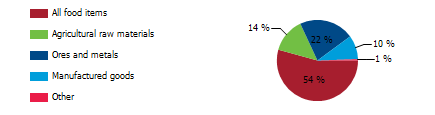
Export structure by product group in 2023 (% of total exports) (UNCTAD)
The export structure of a country reflects the diversity, composition, and value of its goods and services exchanged on the global market, providing essential insights into its economic health, competitiveness, and developmental stage. In the case of Somalia, the export structure heavily relies on livestock and a limited range of agricultural products. To fortify economic stability and lessen susceptibility to global market fluctuations, there is a significant opportunity for Somalia to diversify its export base and invest in value-added processing initiatives.
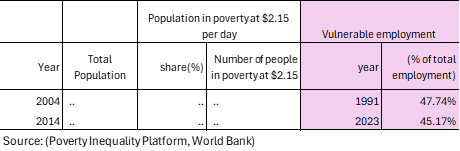
Poverty and vulnerable employment in Somalia
In 2023, 45 percent of jobs in Somalia were considered vulnerable employment, which means they lack job security, pay low wages, and do not provide social protections like health insurance or pensions. This type of work mainly includes self-employed individuals, such as street vendors and small farmers, as well as family members who help in family businesses without pay. These jobs are often informal and unstable, putting workers at risk of financial crises, exploitation, and poverty. The consequences of vulnerable employment extend beyond individuals, impacting families and communities, and leading to persistent cycles of hardship that are hard to escape.
Understanding poverty level significance at $2.15 per day
The poverty level at $2.15 per day (measured in 2017 purchasing power parity, or PPP) is a key global benchmark used by the World Bank to define extreme poverty in low-income countries. It indicates:
1. Basic Survival Threshold
• People living below $2.15 per day struggle to afford essential needs such as food, clean water, shelter, healthcare, and education.
2. Economic Underdevelopment
• A high percentage of a country’s population living below this threshold suggests low economic productivity, high unemployment, and weak social safety nets.
3. Inequality and Social Vulnerability
• It reflects deep income inequality and a lack of access to opportunities for upward mobility.
• People in this category are more vulnerable to shocks like food price increases, climate disasters, or health crises.
4. Policy Challenges
• Governments need targeted interventions such as social welfare programs, job creation, and improved access to education and healthcare to reduce poverty.
A country's export structure is a reflection of its level of development and productive capacities
The export structure of a country refers to the composition, diversity, and value of the goods and services it sells to other countries. It provides key insights into the country’s economic health, competitiveness, and level of development. Productive capacities of a country refer to its ability to produce goods and services efficiently and sustainably over time. These capacities are shaped by various factors, including human capital, natural resources, infrastructure, private sector, development, technology & innovation, institutions & governance, financial systems trade & market access (UNCTAD).
Here’s what the export structure and productive capacities of a country typically indicate:
- Level of Economic Development
- Developed economies usually export high-value manufactured goods, technology, and services.
- Developing economies often rely on raw materials, agricultural products, or low-value manufactured goods.
- Industrial and Sectoral Strengths
- A strong presence of high-tech or industrial goods (e.g., machinery, electronics) suggests a well-developed manufacturing sector.
- A dominance of commodities (e.g., oil, minerals, agricultural products) indicates reliance on natural resources.
- Export Diversification
- A diverse export base (multiple industries) makes a country’s economy more stable and resilient to global price shocks.
- A concentrated export base (few key products) makes it vulnerable to market fluctuations.
- Trade Partnerships and Dependence
- If exports are heavily dependent on a single country or region, the economy is more exposed to geopolitical and trade risks.
- A wide range of trading partners indicates stronger global integration.
- Competitiveness and Value Addition
- Exporting mainly raw materials (e.g., crude oil instead of refined petroleum) suggests limited industrial processing capacity.
- A high share of finished and high-tech goods suggests strong value addition and competitiveness.
Somalia-Sanitation
Somalia – Proportion of population served with at least basic sanitation
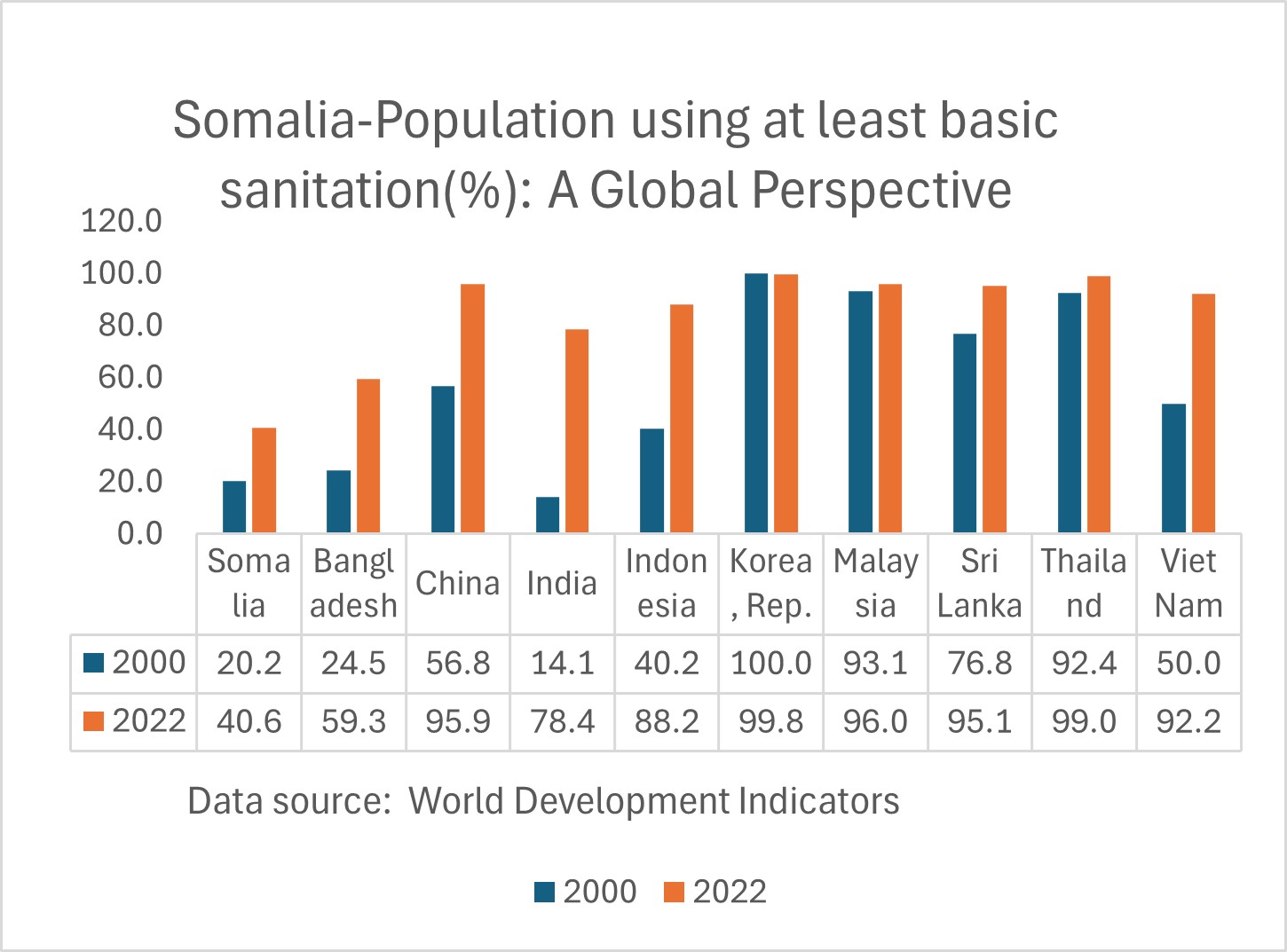
In 2022, proportion of population served with at least basic sanitation for Somalia was 40.6 %. Proportion of population served with at least basic sanitation of Somalia increased from 20.2 % in 2000 to 40.6 % in 2022 an absolute change of 20.4 percentage points (pp) between 2000 and 2022.
Somalia – Proportion of urban population served with at least basic sanitation
In 2022, proportion of urban population served with at least basic sanitation for Somalia was 57 %. Proportion of urban population served with at least basic sanitation of Somalia increased from 46.5 % in 2000 to 57.0 % in 2022 an absolute change of 10.5 pp between 2000 and 2022.
Somalia – Proportion of rural population served with at least basic sanitation
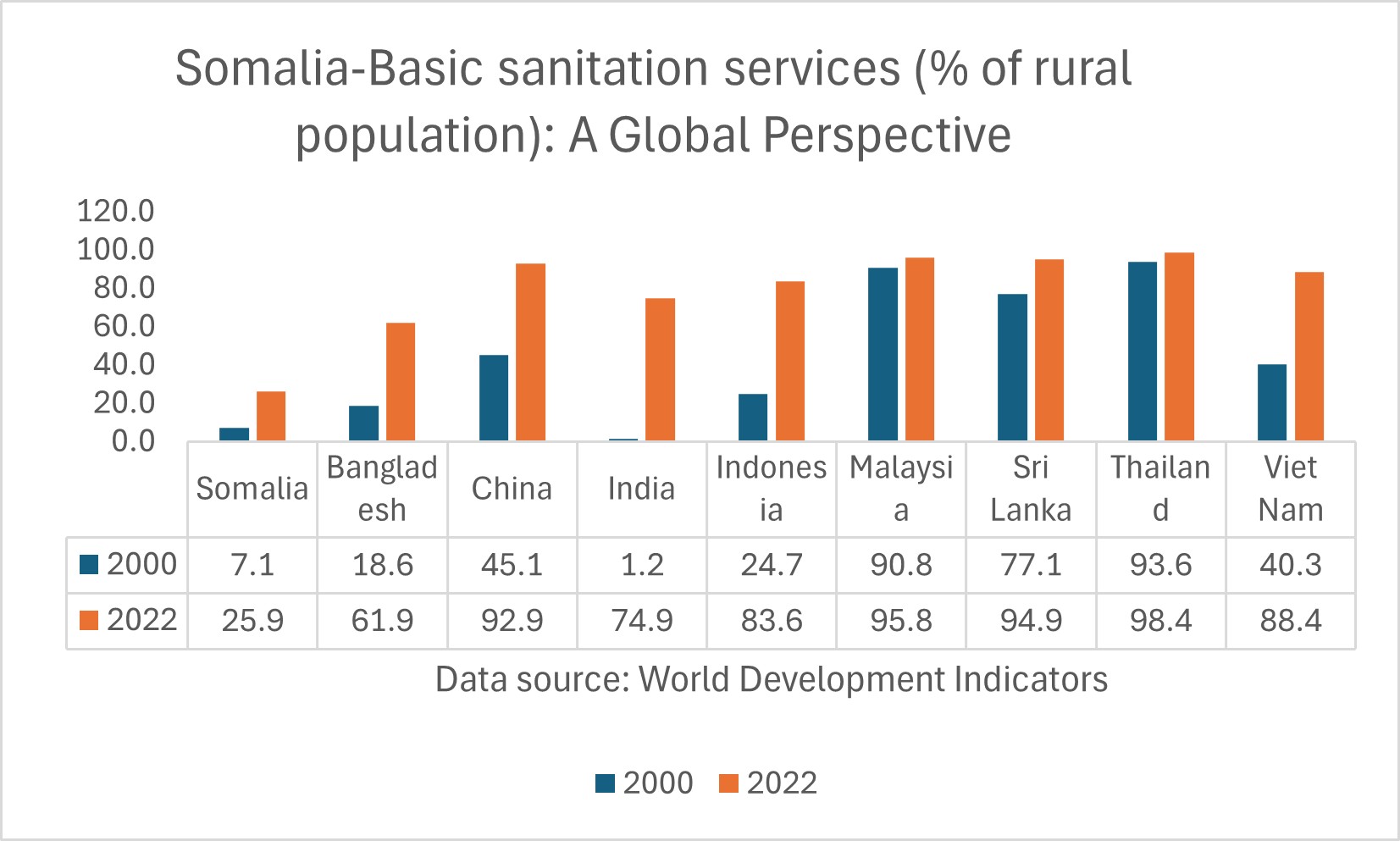
In 2022, proportion of rural population served with at least basic sanitation for Somalia was 25.9 %. Proportion of rural population served with at least basic sanitation of Somalia increased from 7.1 % in 2000 to 25.9 % in 2022, an absolute change of 18.8 pp between 2000 and 2022.
Somalia – Proportion of population served with at least basic sanitation: A Global Perspective
The ongoing lack of safe sanitation is a critical challenge affecting millions and requires our immediate collective action to prevent tragic loss of life, highlighting a major public health crisis. Access to safe sanitation is a fundamental human right that we must ensure for everyone. In 2022, nearly 59 percent of Somalia’s population endured inadequate sanitation, a stark contrast to nations like Vietnam, China, and Thailand, where only 8 percent, 5 percent, and 1 percent respectively lacked these essential services. The global average of individuals without proper sanitation access is around 6 percent, emphasizing the urgent need for united efforts to enhance sanitation access in underserved regions of Sub-Saharan Africa.
Somalia – Proportion of rural population served with at least basic sanitation: A Global Perspective
In 2022 nearly 7 million people in rural Somalia about 74 percent of the population faced a severe lack of basic sanitation facilities starkly contrasting with countries like Vietnam, Sri Lanka, and Thailand where those figures were just 12 percent 5 percent and 2 percent respectively. This lack of safe sanitation is not only a pressing issue but a heartbreaking reality that demands our urgent collective action as it leads to the tragic loss of countless lives each year, deepening a critical public health crisis that needs our thoughtful intervention. Safe sanitation is a fundamental human right that everyone deserves without exception. Let us unite to advocate for this essential right across Sub-Saharan Africa where the need is urgent and the potential for meaningful community transformation is vital for the dignity and well-being of all individuals involved
Somalia-Water Supply
Somalia- Proportion of total population served with at least basic water
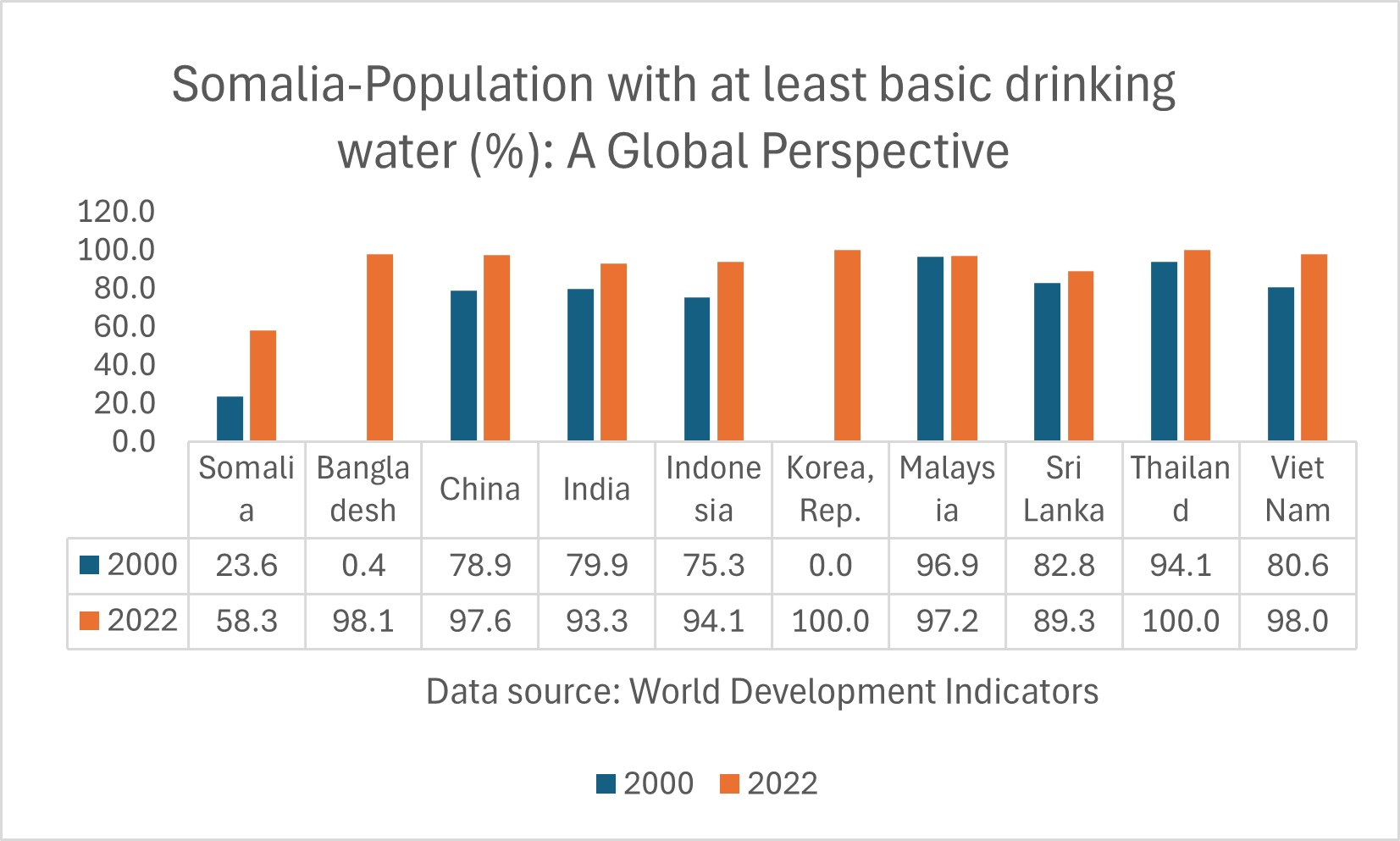
In 2022, proportion of population served with at least basic water for Somalia was 58.3 %. Proportion of population served with at least basic water of Somalia increased from 23.6 % in 2000 to 58.3 % in 2022 an absolute change of 34.6 pp between 2000 and 2022.
Somalia – Proportion of urban population served with at least basic water
In 2022, proportion of urban population served with at least basic water for Somalia was 80.1 %. Proportion of urban population served with at least basic water of Somalia increased from 59.8 % in 2000 to 80.1 % in 2022 an absolute change of 20.3 pp between 2000 and 2022.
Somalia – Proportion of rural population with at least basic water
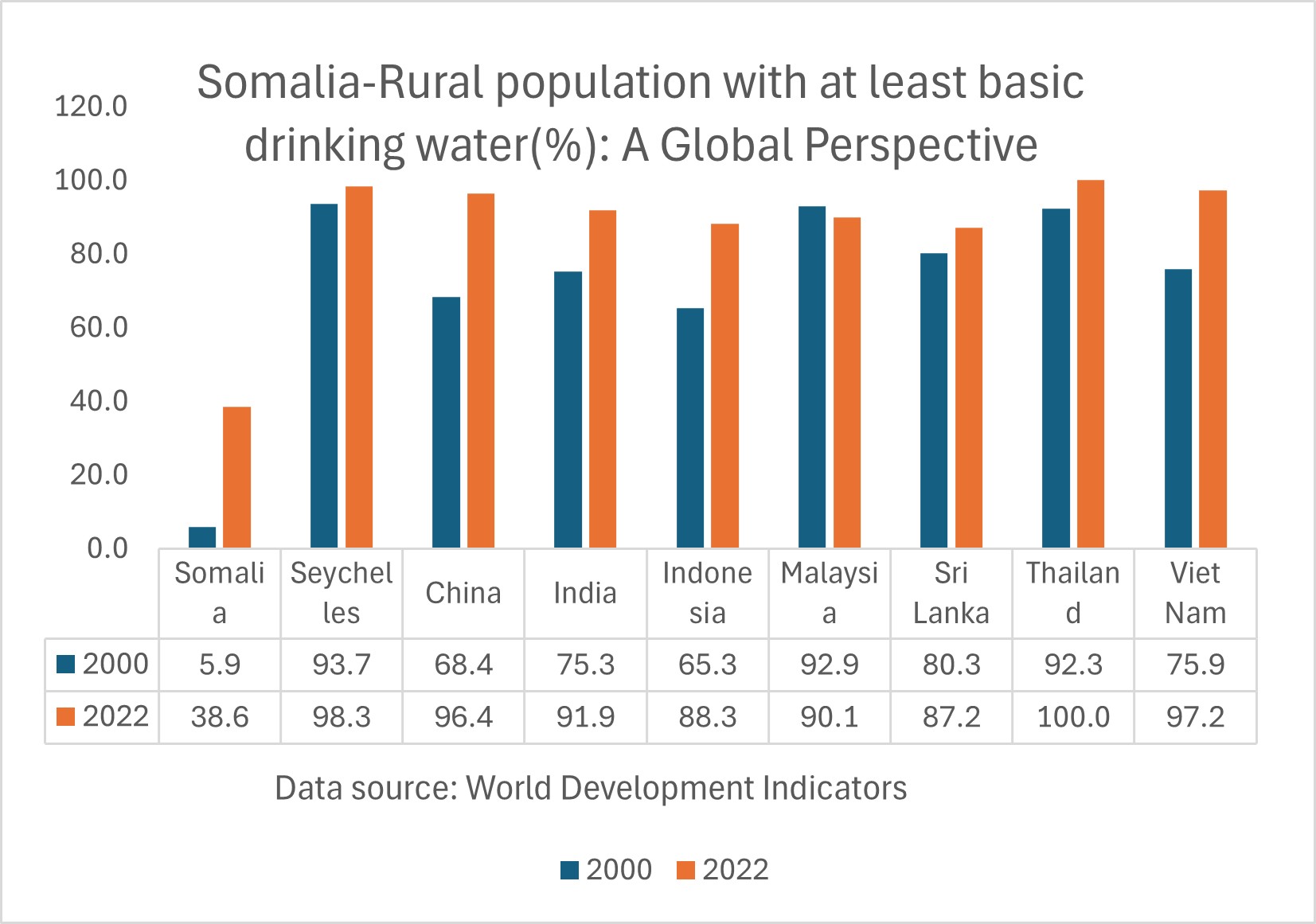
In 2022, proportion of rural population served with at least basic water for Somalia was 38.6 %. Proportion of rural population served with at least basic water of Somalia increased from 5.9 % in 2000 to 38.6 % in 2022 an absolute change of 32.7 pp between 2000 and 2022.
Somalia- Proportion of population served with at least basic drinking water: A Global Perspective
Access to safe drinking water is a fundamental human right that requires immediate and unified action. In 2022, over 7 million people in Somalia, about 42 percent of the population, lacked this vital resource, leading to a serious public health crisis that needs our urgent response. In contrast, everyone in Thailand and 98 percent of the population in Vietnam and Bangladesh had reliable access to safe drinking water in 2022. This stark inequality highlights the urgent need for transformative reforms in Sub-Saharan Africa, where many still lack essential resources to improve their quality of life.
Somalia- Proportion of rural population served with at least basic drinking water: A Global Perspective
In 2022, 61 percent of Somalia’s rural population, around 5.7 million individuals, lacked access to safe drinking water. This situation is not just a statistic, it is a call for urgent intervention, especially when we consider the impressive achievements of countries like Thailand, Bangladesh, and Vietnam, where rural communities have access rates of 100 percent, 98 percent, and 97 percent, respectively. This stark contrast reveals the governance challenges faced by many Sub-Saharan African nations and urges us to unite in improving living conditions and securing essential resources for vulnerable populations affected by these inequalities, reinforcing the belief that through our unified efforts, we can create a meaningful and lasting impact.
Somalia-Access to Electricity
Somalia- Access to electricity (% of population)
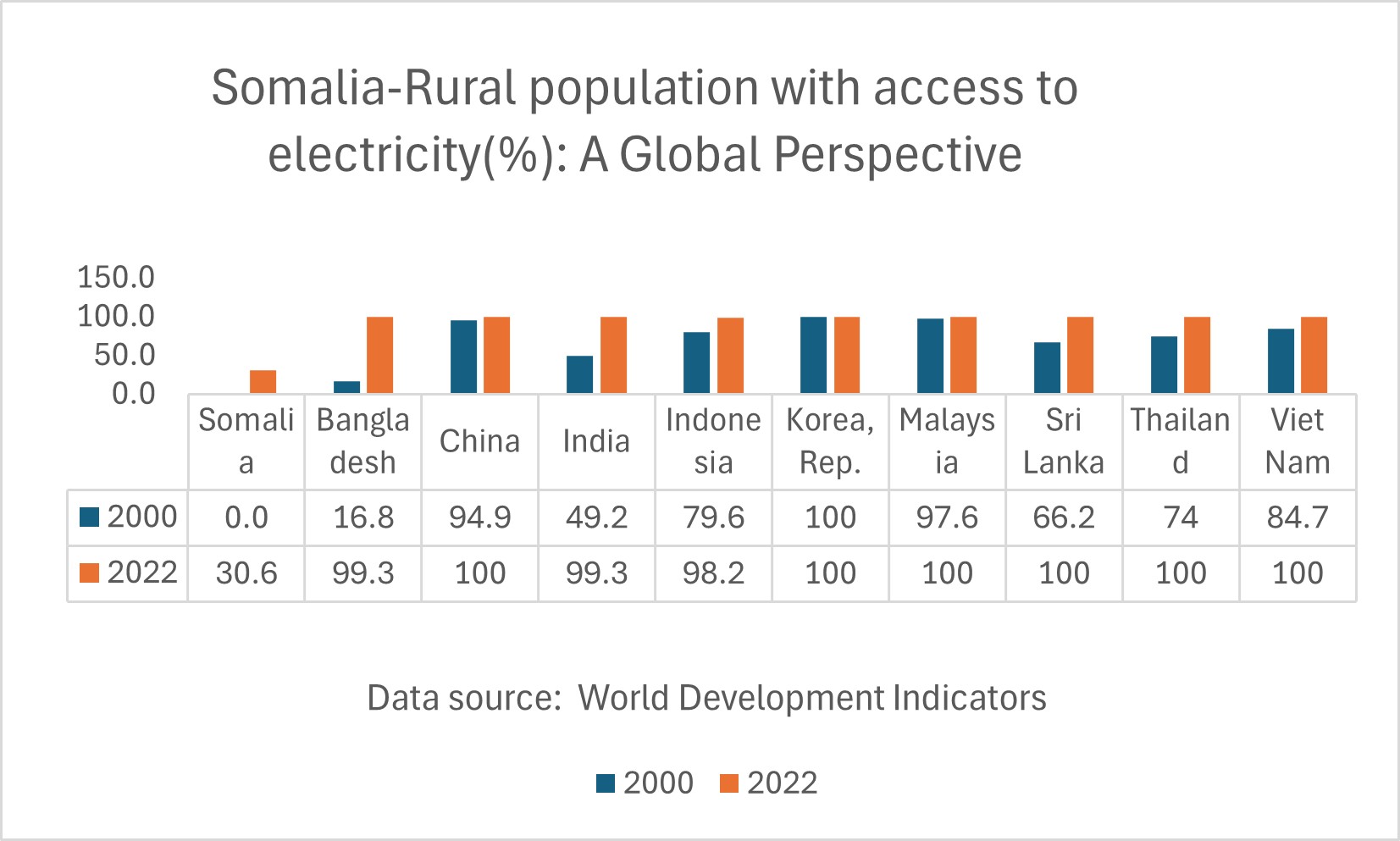
In 2022, proportion of population with access to electricity for Somalia was 48.9 % in 2022. The proportion of population with access to electricity of Somalia increased from 2.1% in 2000 to 48.9% in 2022, an absolute change of 46.8 pp between 2000 and 2022.
Somalia- Access to electricity (% urban population)
In 2022, proportion of urban population with access to electricity for Somalia was 76.7%. The proportion of urban population with access to electricity of Somalia increased from 20.5% % in 2000 to 76.7% in 2022, an absolute change of 56.2 pp between 2000 and 2022.
Somalia- Access to electricity (% of rural population)
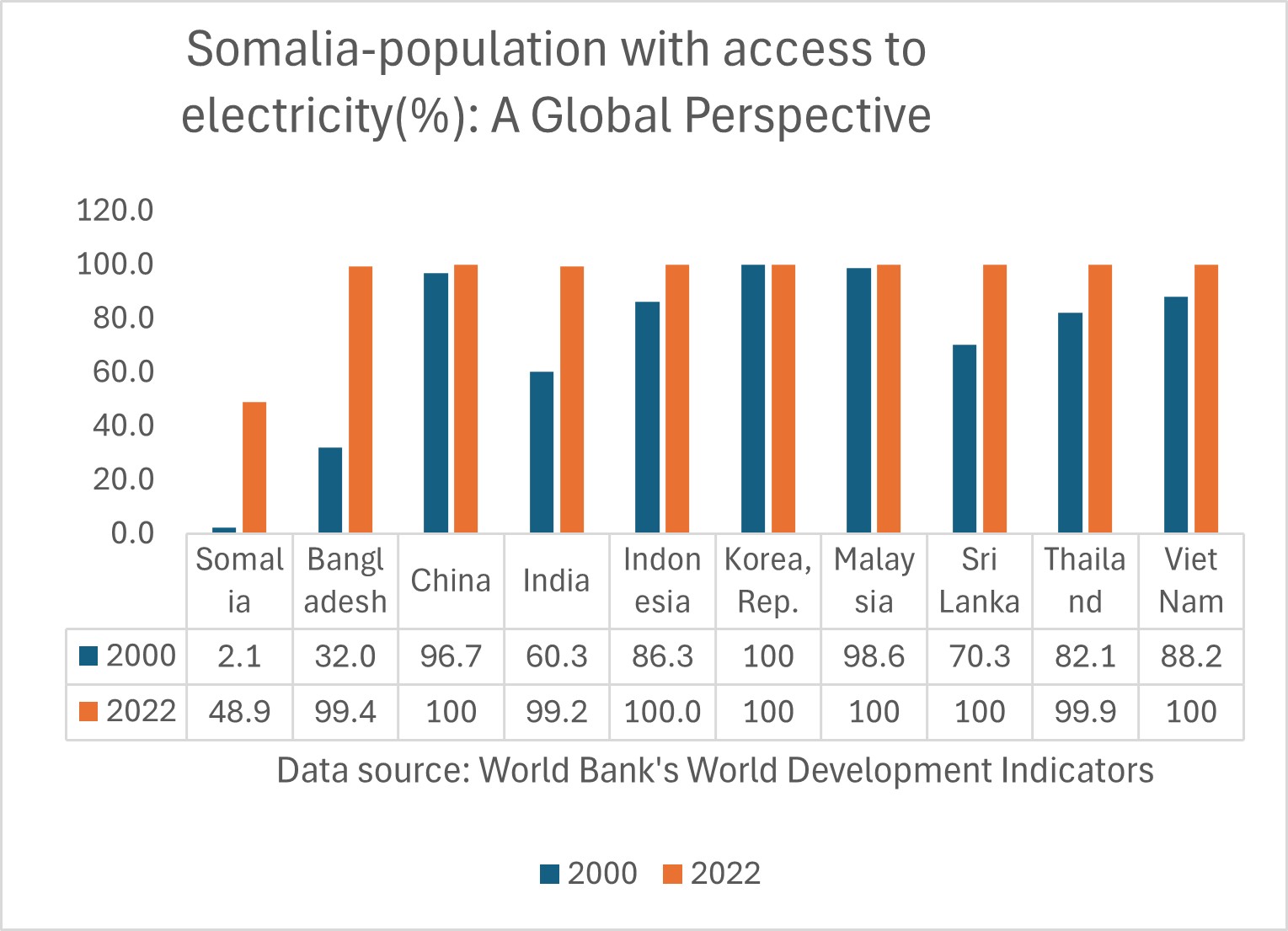
In 2022, proportion of rural population with access to electricity for Somalia was 30.6 %. The proportion of rural population with access to electricity of Somalia gradually declined from 43.2 % in 2010 to 30.6% in 2022, an absolute change of 12.6 pp between 2010 and 2022.
Somalia- Proportion of population served with electricity: A Global Perspective
In 2022, nearly 51 percent of Somalia’s population lacked access to electricity, affecting over 9 million people who are deprived of this vital service essential for their survival and well-being. This dire situation not only highlights a pressing challenge but also calls for action as we observe the progress made in countries like Vietnam, Thailand, Sri Lanka, and Malaysia toward universal electricity access. The contrast underscores the urgent need for reforms across Sub-Saharan Africa to improve living conditions. Living without reliable electricity is a significant barrier to development, health, education, and economic opportunities, which are necessary for uplifting standards of living and fostering hope for a sustainable future for the resilient people of Somalia.
Somalia- Proportion of rural population served with electricity: A Global Perspective
In 2022, 69 percent of Somalia’s rural population, nearly 6.5 million people, lived without electricity, revealing a stark contrast to countries like Vietnam, Thailand, and Sri Lanka, where all rural residents have access to this vital resource. India and Bangladesh exemplify success with 99 percent of their rural citizens enjoying reliable electricity, underscoring the importance of energy access for societal growth. These figures signal a pressing need for governance reforms across Sub-Saharan Africa, essential for ensuring consistent electricity and the comprehensive support necessary for community development.
Somalia: Health outcomes
Somalia-Life expectancy: A Global Perspective
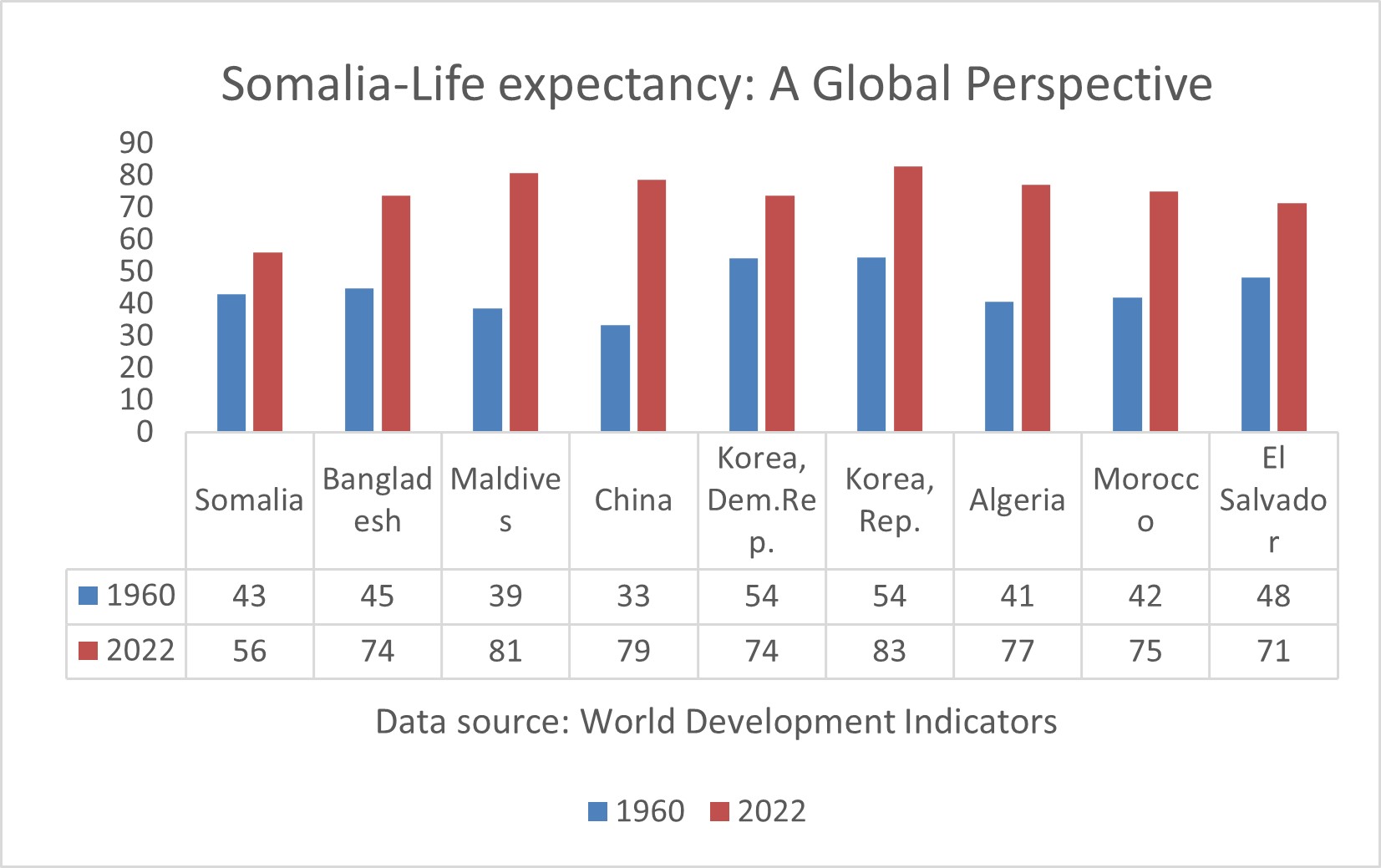
As we reflect on life expectancy trends over the past seven decades, it is evident that while there have been significant strides towards longer and healthier lives, stark inequalities remain, especially in Sub-Saharan Africa. The global average life expectancy for newborns has increased from 47 years in 1950 to 71 years by 2021; however, many countries in Sub-Saharan Africa, such as Somalia, have seen limited improvement, with life expectancy rising from 43 years in 1960 to just 56 years in 2022. In contrast, nations like South Korea have experienced remarkable gains, with life expectancy increasing from 54 years in 1960 to 83 years in 2022, and the Maldives has advanced from 39 years in 1960 to 81 years in 2022. The low life expectancy in several Sub-Saharan African countries underscores the urgent challenges they face, including chronic poverty, inadequate healthcare, and governance issues. This highlights the crucial need for compassionate interventions to foster a sustainable and equitable future for these communities, ensuring that the benefits of global progress are accessible to all.
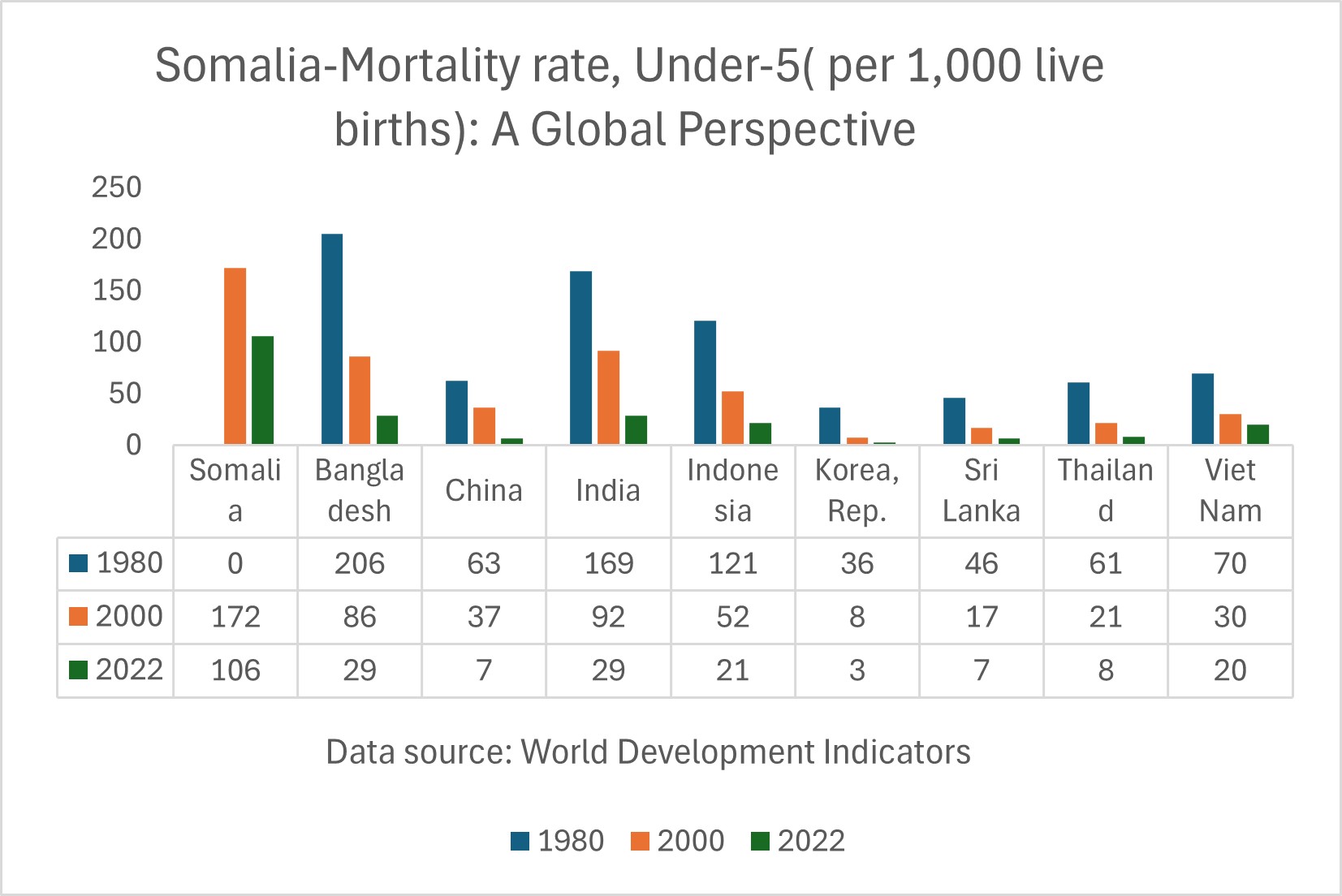
Somalia-Mortality rate, under-5 (per 1,000 live births): A Global Perspective
Since 1950, global child mortality rates have seen a notable decline due to enhancements in living standards, healthcare access, nutrition, and safe drinking water. In affluent regions like Europe and America, these rates are now below four percent, illustrating the benefits of strong healthcare systems and economic stability. Although some developing countries in South America, Asia, and Africa have made progress, many Sub-Saharan African nations still encounter significant challenges. For instance, Somalia’s under-five mortality rate fell from 172 in 2000 to 106 in 2022, showing that progress is attainable. In stark contrast, Bangladesh and India achieved remarkable reductions, decreasing from 206 to 29 and from 169 to 29, respectively. These figures highlight persistent barriers due to inadequate healthcare systems and underline the urgent need for governance reforms in Sub-Saharan Africa to lower child mortality and improve health outcomes. This emphasizes the vital role of international cooperation and investment in sustainable health initiatives to drive impactful change and ensure a healthier future for all children.
Somalia-Maternal mortality ratio (per 100,000 live births): A Global Perspective
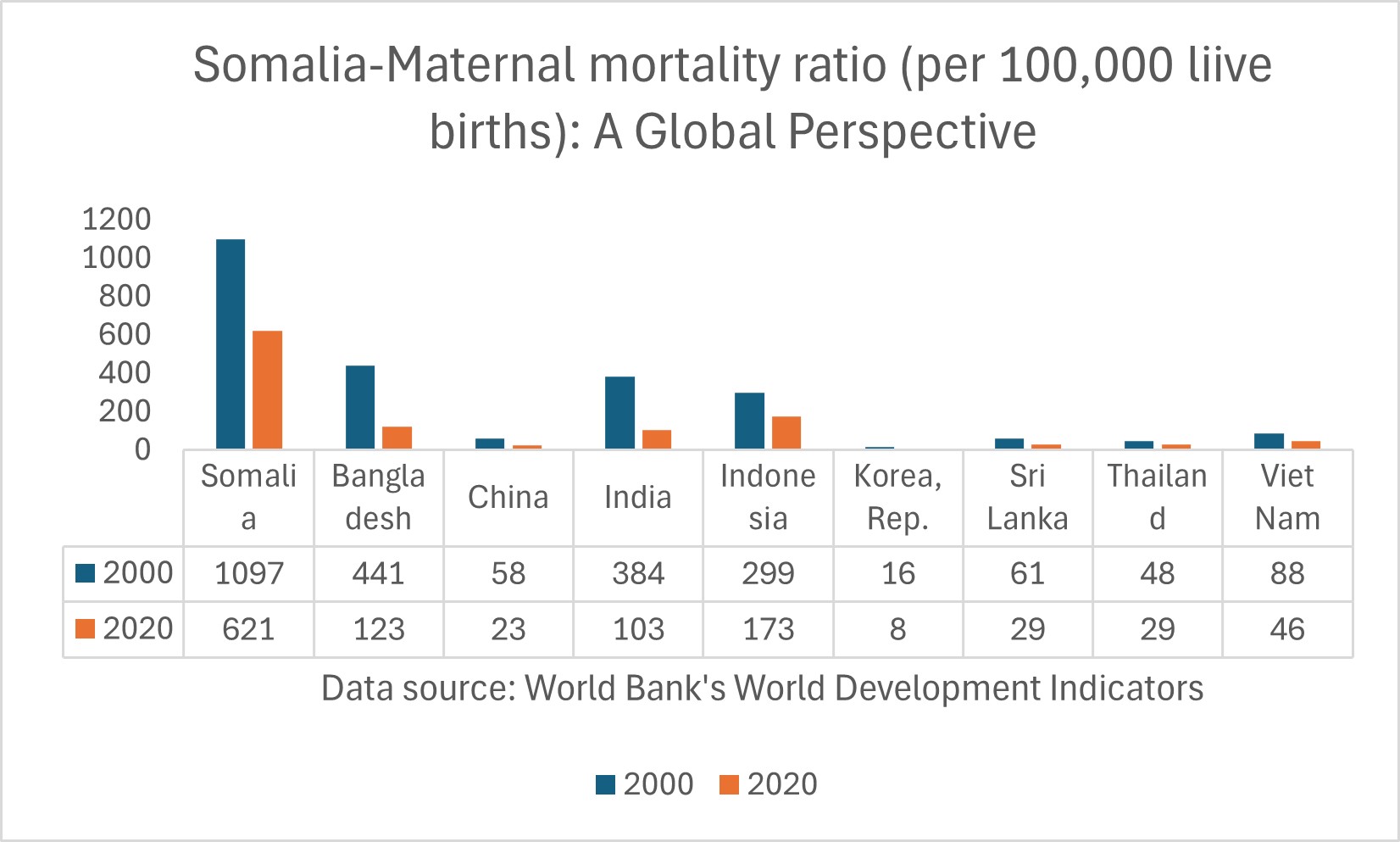
Somalia’s maternal mortality ratio, despite a significant decrease from 1097 in 2000 to 621 in 2020, remains critically high, reflecting the serious challenges mothers face across the country. While this progress is notable, it stands in stark contrast to lower figures in Bangladesh, India, and Vietnam, which reported maternal mortality ratios of 123, 103, and 46 in 2022. These alarming statistics illustrate an ongoing crisis in pregnancy-related deaths in Somalia, further complicated by high birth rates and entrenched maternal health issues that require urgent action. The data reveals critical weaknesses in the healthcare system and highlights the chronic underfunding affecting many Sub-Saharan African nations. The disparities in maternal health outcomes compared to other developing regions underscore the urgent need for significant investment in health infrastructure and resources. The precarious state of maternal and child health in Somalia is an unacceptable reality that demands immediate attention and concerted efforts for effective change.